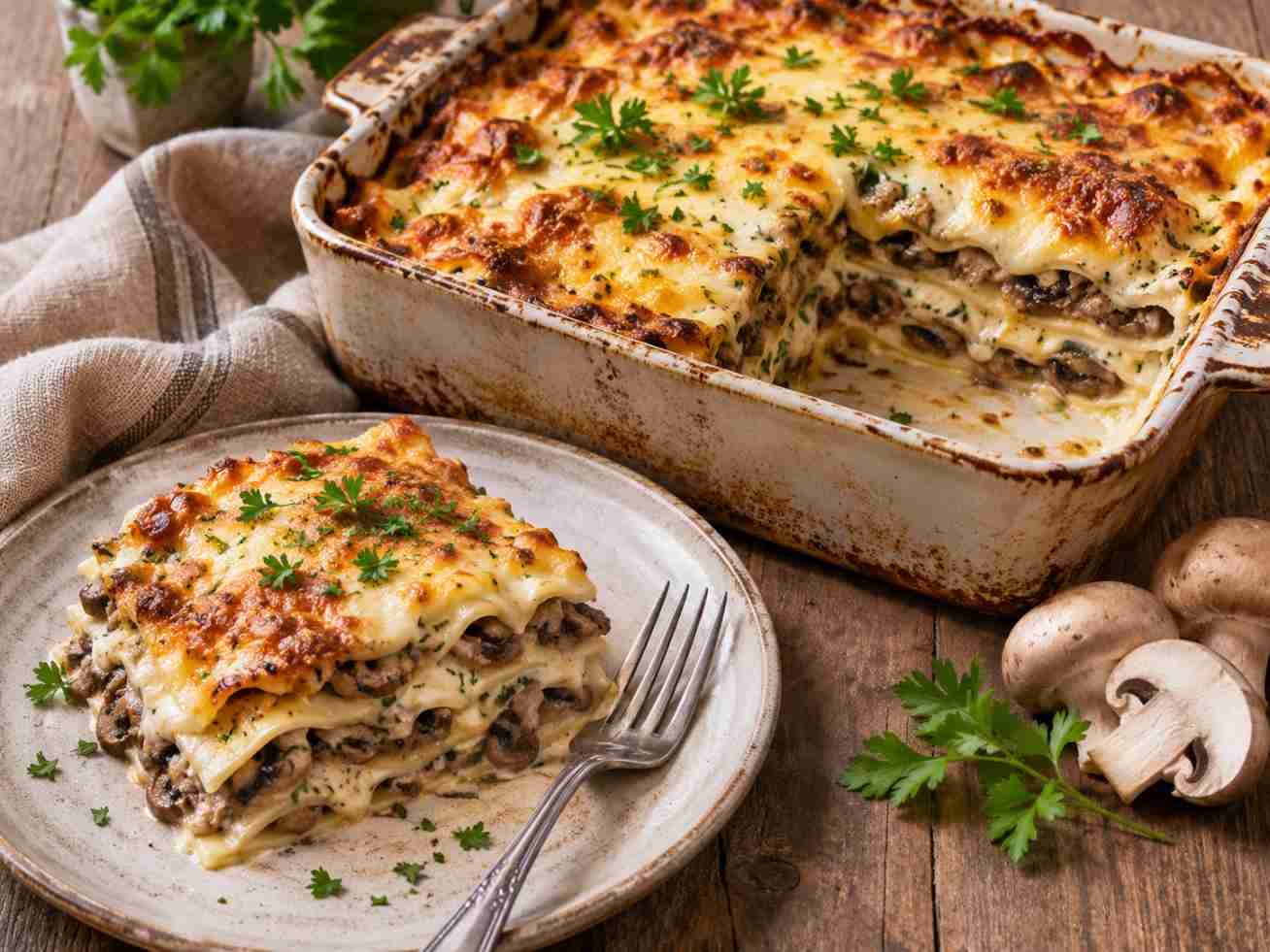
Mushroom lasagne is one of those dishes that makes a little extra time in the kitchen feel worthwhile. Beneath its golden, bubbling cheese topping are layers of tender pasta, mushrooms cooked with garlic and herbs, and a creamy béchamel sauce that holds everything together. It is rich without needing meat, and the mushrooms bring enough savoury depth to make every forkful satisfying.
The important part is getting the mushroom filling right. Mushrooms contain plenty of moisture, and if they go straight into the lasagne without being properly browned, they can leave the pasta sitting in watery sauce. Cooking them in batches until their liquid evaporates makes a noticeable difference. The result is a filling with a deeper, almost roasted flavour that works beautifully with the creamy sauce.
This version uses a combination of button mushrooms and chestnut mushrooms, although you can easily substitute whatever varieties are available. A little tomato paste gives the filling extra body, while thyme, Parmesan and mozzarella bring the familiar flavours of a comforting baked lasagne.
Mushroom Lasagne Recipe Overview
| Preparation Time | 25 minutes |
| Cooking Time | 1 hour 10 minutes |
| Resting Time | 15 minutes |
| Total Time | 1 hour 50 minutes |
| Servings | 6 |
| Course | Main Course |
| Cuisine | Italian-Inspired |
| Cooking Method | Stovetop and Oven |
| Diet | Vegetarian when made with vegetarian cheese |
Ingredients for Mushroom Lasagne
The recipe has three main components: the mushroom filling, the béchamel sauce and the pasta layers. Preparing the filling and sauce separately gives you better control over their consistency before assembling the lasagne.
For the Mushroom Filling
- 500 g button mushrooms, sliced
- 300 g chestnut or cremini mushrooms, sliced
- 2 tablespoons olive oil
- 1 tablespoon unsalted butter
- 1 large onion, finely chopped
- 4 garlic cloves, minced
- 2 tablespoons tomato paste
- 150 ml vegetable stock
- 1 teaspoon dried thyme or 2 teaspoons fresh thyme leaves
- 1 teaspoon dried oregano
- 1 tablespoon soy sauce
- 1/2 teaspoon freshly ground black pepper
- Salt, to taste
- 2 tablespoons fresh parsley, chopped
For the Béchamel Sauce
- 60 g unsalted butter
- 60 g all-purpose flour
- 800 ml whole milk, preferably warm
- 1/4 teaspoon ground nutmeg
- 1/2 teaspoon salt, or to taste
- 1/4 teaspoon freshly ground black pepper
- 40 g finely grated Parmesan-style vegetarian hard cheese
For Assembling the Lasagne
- Approximately 200 g dried oven-ready lasagne sheets, or enough for three pasta layers
- 180 g shredded mozzarella cheese
- 40 g grated Parmesan-style vegetarian hard cheese
- 1 teaspoon olive oil or a little butter for greasing the baking dish
- Fresh parsley or basil, for serving
Ingredient note: Traditional Parmesan is made with animal rennet. If preparing a strictly vegetarian lasagne, choose a vegetarian hard cheese instead. Also check whether your lasagne sheets are oven-ready or require boiling before use.
Also Read: Picadillo de Carne Molida Recipe
How to Make Mushroom Lasagne
Step 1: Prepare the Mushrooms
Wipe the mushrooms clean with a damp kitchen towel and trim any dry stem ends. Slice them into pieces about 5 mm thick. Try not to cut them too thinly because they shrink considerably during cooking. If using a mixture of mushrooms, keep the slices roughly the same size so they cook evenly.
Step 2: Brown the Mushrooms
Heat 1 tablespoon of olive oil in a large, wide frying pan over medium-high heat. Add half the mushrooms and spread them across the pan. Leave them undisturbed for a couple of minutes before stirring. Continue cooking for about 7–9 minutes, until their released moisture has evaporated and the mushrooms develop browned edges. Transfer them to a plate and repeat with the remaining mushrooms and olive oil. Avoid overcrowding the pan, as this encourages steaming instead of browning.
Step 3: Build the Mushroom Filling
Reduce the heat to medium and melt 1 tablespoon of butter in the same pan. Add the chopped onion and cook for 4–5 minutes until softened. Stir in the garlic and cook for another 30 seconds. Add the tomato paste, thyme and oregano, stirring for about a minute to cook out the raw flavour of the paste. Return the mushrooms to the pan, pour in the vegetable stock and add the soy sauce. Simmer for 5–7 minutes, stirring occasionally, until most of the liquid has reduced. The filling should be moist but not soupy. Finish with black pepper, parsley and salt as needed. Remove from the heat.
Step 4: Prepare the Béchamel Sauce
Melt 60 g butter in a medium saucepan over medium-low heat. Add the flour and whisk continuously for approximately 2 minutes. The mixture should look smooth and slightly foamy, without turning brown. Slowly pour in the warm milk, adding a little at a time while whisking to prevent lumps. Once all the milk has been incorporated, cook for 5–8 minutes, stirring frequently, until the sauce thickens enough to lightly coat the back of a spoon. Add the nutmeg, salt, black pepper and 40 g grated vegetarian hard cheese. Stir until the cheese melts, then remove the saucepan from the heat.
The béchamel should remain pourable. If it becomes too thick, whisk in a small splash of milk. Oven-ready lasagne sheets need moisture to soften while baking, so an overly thick sauce can leave the pasta undercooked.
Step 5: Prepare the Baking Dish
Preheat the oven to 190°C (375°F), or 170°C (340°F) for a fan-assisted oven. Lightly grease a baking dish approximately 23 × 33 cm (9 × 13 inches). Spread a thin layer of béchamel sauce across the bottom. This prevents the first pasta layer from sticking and provides moisture for the sheets to cook.
Step 6: Assemble the Lasagne
Place a single layer of lasagne sheets over the béchamel, trimming them if necessary to fit the dish. Spread half the mushroom filling over the pasta, followed by roughly one-quarter of the remaining béchamel sauce. Sprinkle over a little mozzarella. Add another layer of pasta, the remaining mushrooms, another portion of béchamel and some mozzarella. Cover with a final layer of pasta, then spread the remaining béchamel generously across the surface, making sure all the exposed pasta is covered. Finish with the remaining mozzarella and 40 g grated vegetarian hard cheese.
Do not press the layers down too firmly. The sauce needs enough room to move around the pasta sheets as they absorb moisture during baking.
Step 7: Bake Until Golden
Cover the baking dish loosely with aluminium foil, keeping the foil from touching the cheese if possible. Bake for 25 minutes, then remove the foil and continue baking for another 15–20 minutes. The top should be golden with bubbling sauce around the edges. Insert a knife into the centre to check that the pasta is tender. If the top browns before the sheets finish cooking, cover the dish again and bake for a few more minutes.
Step 8: Allow the Lasagne to Rest
Remove the lasagne from the oven and leave it undisturbed for at least 15 minutes before cutting. It might be tempting to serve immediately, but resting allows the sauce to settle and makes the portions easier to lift without the layers sliding apart. Scatter fresh parsley or basil over the top just before serving.
Also Read: Best Vegetable Lasagna Recipe
What You Can Do Better
Choose More Than One Type of Mushroom
Button mushrooms work perfectly well on their own, but a mixture of varieties gives the filling a more interesting flavour. Chestnut mushrooms contribute an earthier taste, while a handful of shiitake mushrooms can add a deeper savoury note. If you have dried porcini mushrooms, soak a small amount in hot water, chop them finely and add them to the filling. Strain the soaking liquid through a fine filter before using a little of it in place of vegetable stock.
Let the Mushrooms Brown Properly
This is probably the most useful improvement you can make. Mushrooms release a surprising amount of water, especially when packed tightly into a pan. Cook them in batches, use a fairly high heat and wait until the moisture disappears before taking them off the stove. The browned edges provide much of the filling’s flavour, so this step is worth the extra few minutes.
Keep the Béchamel Smooth and Lightly Seasoned
A good béchamel should be creamy without feeling like a heavy paste. Warm milk is easier to incorporate into the butter and flour mixture, and adding it gradually helps prevent lumps. Taste the finished sauce before assembling the lasagne. It needs enough seasoning to carry the pasta, but remember that the cheeses also contribute salt.
Make Sure the Pasta Has Enough Moisture
Oven-ready lasagne sheets absorb liquid as they bake. Covering the pasta completely with sauce, particularly around the edges, helps prevent dry or chewy corners. If your mushroom filling has reduced too far or your béchamel has thickened while standing, loosen them with a little stock or milk before assembling.
Give the Lasagne Time to Set
Lasagne that comes straight from the oven often looks messy when sliced, even when it tastes excellent. A 15-minute rest helps the filling and sauce settle between the pasta sheets. For particularly tidy portions, allow it to stand for 20 minutes. It will still be pleasantly hot when served.
Variations and Ingredient Substitutions
Spinach and Mushroom Lasagne
For a little greenery, add 150 g fresh spinach to the cooked mushroom mixture and stir until wilted. If using frozen spinach, thaw it completely and squeeze out as much moisture as possible before adding it. Excess water can thin the filling and make the finished lasagne difficult to slice.
Ricotta and Mushroom Lasagne
For a softer, creamier filling, spread about 200 g ricotta in small spoonfuls between the mushroom layers. Season the ricotta with black pepper and a little lemon zest beforehand. Since ricotta adds richness and moisture, you can reduce the mozzarella slightly if preferred.
Vegan Mushroom Lasagne
Replace the butter with olive oil or a plant-based butter alternative. Prepare the béchamel with unsweetened soy milk or oat milk, and use suitable dairy-free cheeses for the topping. Check that the pasta sheets contain no eggs and use plant-based alternatives to the hard cheese. The sauce may thicken differently depending on the milk, so adjust its consistency before assembling.
Extra-Herby Mushroom Lasagne
Fresh thyme is particularly good with mushrooms, but rosemary and sage also work in small amounts. Add finely chopped rosemary to the onions or stir a few shredded sage leaves into the mushroom mixture. Use these stronger herbs sparingly so they complement rather than overpower the mushrooms.
Also Read: Steak Fried Rice
What to Serve with Mushroom Lasagne
Because mushroom lasagne is already rich and filling, the best side dishes tend to be fresh and relatively simple. A green salad with lemon vinaigrette adds some welcome acidity, while steamed green beans or roasted asparagus provide a lighter contrast to the creamy pasta. Garlic bread is another good option, particularly when there is extra sauce left on the plate.
For a family dinner, a bowl of sliced tomatoes dressed with olive oil, salt and fresh basil is often enough. The slight sharpness of the tomatoes balances the cheese and mushrooms without adding much preparation time.
How to Store and Reheat Mushroom Lasagne
Refrigerating Leftovers
Allow the lasagne to cool slightly, then transfer leftovers to shallow airtight containers and refrigerate within two hours of cooking. Keep refrigerated at 4°C (40°F) or below and eat within 3–4 days. Individual portions are useful if you want to reheat only what you need.
Freezing Mushroom Lasagne
Mushroom lasagne can be frozen after baking and cooling. Wrap individual portions securely or place them in freezer-safe containers. For the best texture, use within 2–3 months. The béchamel may separate slightly after freezing, but gentle reheating usually brings the dish back to a creamy consistency. Thaw overnight in the refrigerator when possible.
Reheating in the Oven
Place the lasagne in an oven-safe dish and add a tablespoon or two of water or milk around the edges if it appears dry. Cover with foil and heat at 180°C (350°F) until hot throughout. Individual refrigerated portions commonly take about 20–25 minutes, while larger portions need longer. Reheat the centre to 74°C (165°F).
Reheating in the Microwave
Place a portion on a microwave-safe plate, cover loosely and heat in short intervals, checking the centre and allowing it to stand briefly so the heat distributes evenly. Continue until thoroughly heated. Avoid overheating, which can make the pasta rubbery and cause the sauce to separate.
Also Read: Dry Pinto Beans Recipe
Nutritional Information
The following values are approximate estimates for one serving when the recipe is divided into six equal portions. They are based on the listed ingredients and typical ingredient composition. Actual values will vary depending on the cheese, milk, pasta sheets and quantities used.
| Nutrient | Approximate Amount Per Serving |
|---|---|
| Calories | 590 kcal |
| Carbohydrates | 52 g |
| Protein | 27 g |
| Total Fat | 31 g |
| Saturated Fat | 17 g |
| Dietary Fiber | 4 g |
| Total Sugars | 13 g |
| Sodium | 850 mg |
| Cholesterol | 90 mg |
| Calcium | 540 mg |
| Potassium | 850 mg |
Nutrition disclaimer: These figures are estimates, not laboratory-tested values. The amount of added salt and the brands of pasta, cheese, stock and soy sauce can significantly affect the final nutritional profile, particularly sodium.
Frequently Asked Questions
Can I Make Mushroom Lasagne a Day Ahead?
Yes. Assemble the lasagne, cover it tightly and refrigerate for up to 24 hours before baking. Keep it chilled until you are ready to cook. Because the dish will be cold, it may need an additional 10–15 minutes in the oven. Check that the pasta is tender and the centre is thoroughly heated before serving.
Can I Use Only Button Mushrooms?
Absolutely. Button mushrooms are widely available and work well in this recipe. Their flavour is milder than chestnut or shiitake mushrooms, so give them enough time to brown properly. A little extra thyme or a small amount of finely chopped dried porcini can also deepen the flavour.
Why Is My Mushroom Lasagne Watery?
The most common reason is excess moisture in the mushroom filling. Mushrooms need to release their liquid and brown before the sauce is added. A filling that still looks watery in the frying pan will usually remain too loose after baking. Watery vegetables, thin béchamel and cutting the lasagne immediately after baking can contribute to the same problem.
Do I Need to Boil Lasagne Sheets First?
That depends on the type of pasta. Oven-ready sheets are designed to soften in the sauce during baking and do not generally require boiling. Traditional dried sheets may need precooking, depending on the manufacturer’s instructions. Fresh pasta sheets often cook more quickly, so you may need to adjust the covered baking time.
Can I Make Mushroom Lasagne Without Tomato Paste?
Yes. Tomato paste is included for a little acidity, colour and savoury depth, but the dish works without it. Simply omit the paste and allow the mushrooms, garlic, herbs and cheese to provide the main flavours. You can add a small splash of vegetable stock if the filling seems too dry.
How Do I Stop the Lasagne from Becoming Dry?
Use enough béchamel to coat every pasta layer and make sure the corners and edges of the top sheets are covered. Keep the baking dish covered with foil for the first part of cooking, then uncover it to brown the cheese. If the sauce seems very thick before assembly, add a little milk to make it easier to spread.