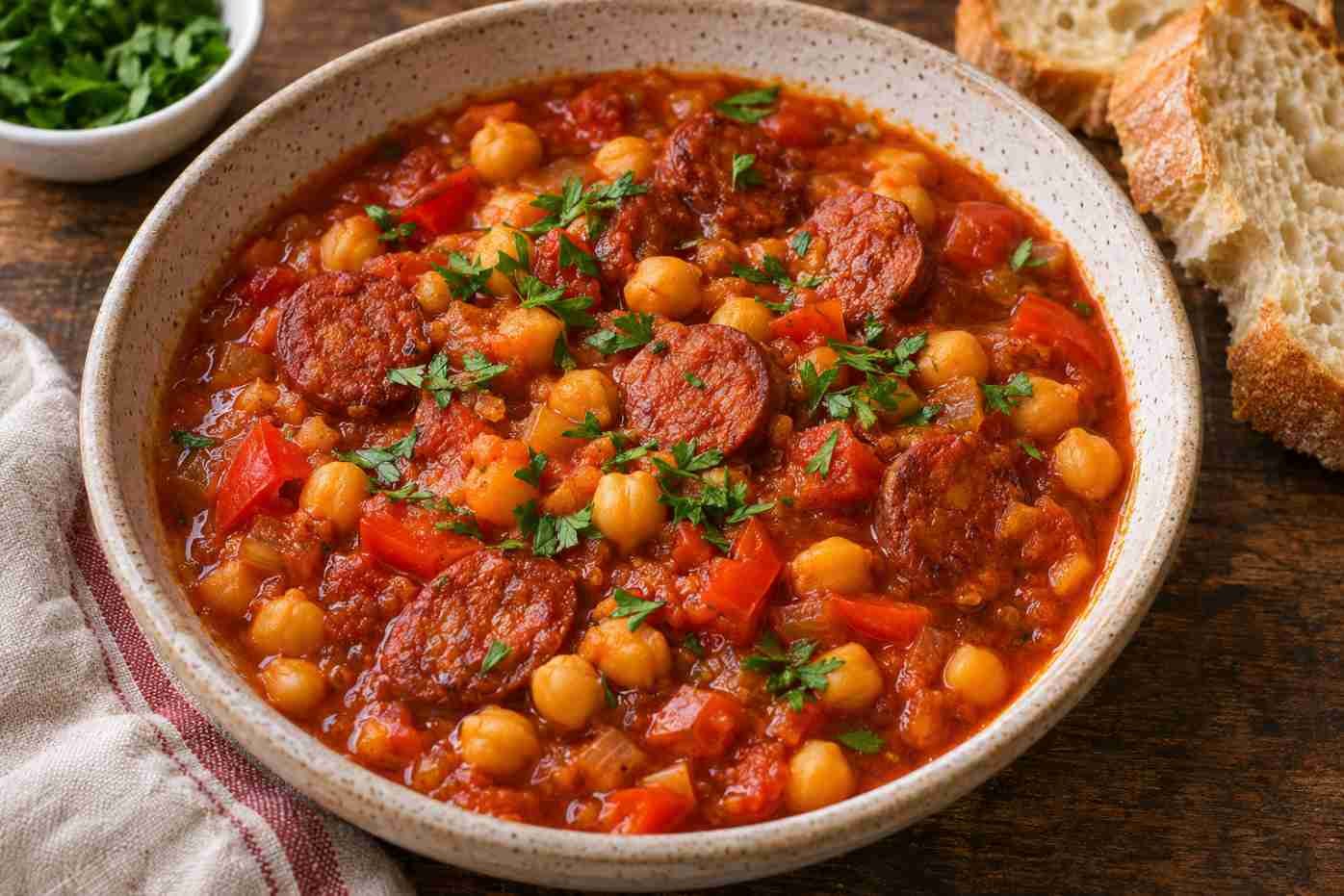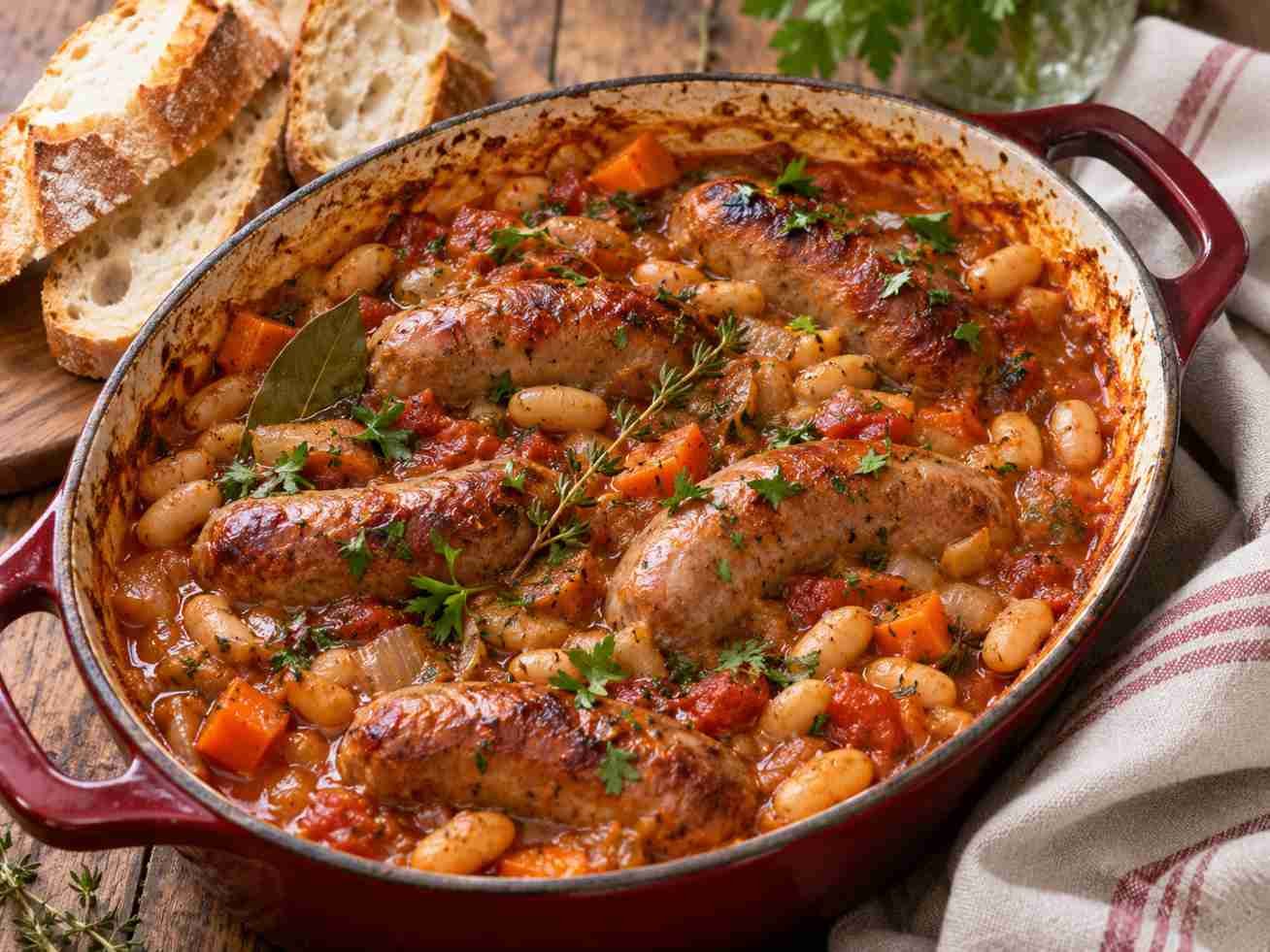
There is something especially comforting about a casserole that spends a little time bubbling away on the stove before going into the oven. The kitchen starts to smell of browned sausages, garlic, herbs, and a rich tomato broth, and by the time dinner is ready, all you really need alongside it is a piece of crusty bread.
This French Sausage & Bean Casserole takes its inspiration from cassoulet, the traditional slow-cooked bean dish from southwestern France. A classic cassoulet can involve several kinds of meat and a lengthy cooking process. This version keeps things simpler, using good sausages, creamy white beans, vegetables, and a handful of pantry ingredients to create a satisfying family dinner without spending half the day in the kitchen.
The sausages develop a beautifully browned exterior, while the beans absorb the flavors of the broth, thyme, garlic, and tomatoes. A short finish in the oven thickens the sauce and gives the casserole a slightly rustic, baked surface.
French Sausage & Bean Casserole Recipe Overview
| Details | Information |
|---|---|
| Preparation Time | 20 minutes |
| Cooking Time | 55 minutes |
| Total Time | 1 hour 15 minutes |
| Servings | 6 |
| Course | Main Course, Dinner |
| Cuisine | French-Inspired |
| Cooking Method | Stovetop and Oven |
| Difficulty | Easy to Moderate |
Ingredients for French Sausage & Bean Casserole
Most of the ingredients are ordinary grocery-store staples. The two things worth paying a little extra attention to are the sausages and the beans. A flavorful sausage provides much of the seasoning, while beans that hold their shape will give the finished casserole a better texture.
For the Casserole
| Ingredient | Quantity |
|---|---|
| Pork sausages or Toulouse-style sausages | 6 medium sausages (about 600 g) |
| Canned cannellini beans, drained and rinsed | 3 cans (400 g each, about 720 g drained) |
| Olive oil | 1 tablespoon |
| Yellow onion, finely chopped | 1 large |
| Carrots, diced | 2 medium |
| Celery stalks, diced | 2 |
| Garlic cloves, minced | 4 |
| Tomato paste | 2 tablespoons |
| Crushed tomatoes | 1 can (400 g) |
| Low-sodium chicken stock | 400 ml |
| Fresh thyme | 4 sprigs |
| Bay leaves | 2 |
| Smoked paprika | 1 teaspoon |
| Freshly ground black pepper | 1/2 teaspoon |
| Salt | To taste |
| Fresh parsley, chopped | 2 tablespoons |
| Red wine vinegar | 1 teaspoon |
For the Optional Breadcrumb Topping
| Ingredient | Quantity |
|---|---|
| Fresh breadcrumbs | 1/2 cup |
| Olive oil | 1 tablespoon |
| Fresh parsley, finely chopped | 1 tablespoon |
Also Read: Cream Corn Casserole with Cheese
Choosing the Right Sausages and Beans
Which Sausages Work Best?
Toulouse-style pork sausages are a natural choice because their garlic and pepper seasoning suits this kind of French country cooking. They are not essential, though. Good-quality plain pork sausages work very well, as do lightly seasoned garlic sausages. Avoid strongly sweet varieties because their flavor can overwhelm the beans and herbs.
If you prefer chicken or turkey sausages, they can be substituted in the same quantity. Choose a variety with enough seasoning to carry through the sauce. The cooking time may need a slight adjustment depending on the thickness and type of sausage.
Which Beans Should You Use?
Cannellini beans are particularly good here. They have tender skins, creamy centers, and a mild flavor that works well with sausage. Great Northern beans are another reliable choice, while butter beans make the casserole a little more substantial.
Canned beans keep the preparation manageable. Drain and rinse them before adding them to the pot. If using dried beans, soak and cook them separately until tender before starting the casserole. Do not rely on the final oven cooking to soften dried beans.
Also Read: Squash Casserole with Stuffing Top
How to Make French Sausage & Bean Casserole
The method is straightforward: brown the sausages, soften the vegetables, build the sauce, and let everything finish together in the oven. Use a large oven-safe casserole dish or Dutch oven if you have one. Otherwise, prepare the casserole in a deep skillet and transfer it to a baking dish before the final stage.
Step 1: Prepare the Ingredients
Preheat the oven to 190°C (375°F), or 170°C (340°F) for a fan-assisted oven. Finely chop the onion, dice the carrots and celery into small, even pieces, and mince the garlic. Drain and rinse the canned beans. Having everything ready before turning on the stove makes the cooking process much easier.
Step 2: Brown the Sausages
Place a large oven-safe casserole pot over medium heat and add 1 tablespoon of olive oil. Once the oil is hot, add the sausages in a single layer. Cook for approximately 7–9 minutes, turning occasionally until they develop a deep golden-brown color on most sides.
The sausages do not need to be fully cooked at this stage because they will finish cooking in the sauce and oven. Transfer them to a plate and leave the flavorful browned bits in the pot. If the sausages release a large amount of fat, remove the excess, leaving about 1 tablespoon behind.
Step 3: Cook the Vegetables
Reduce the heat to medium-low. Add the chopped onion, carrots, and celery to the same pot. Cook for 7–8 minutes, stirring occasionally, until the onion becomes translucent and the vegetables begin to soften.
Add the minced garlic and stir for another minute. The garlic should smell fragrant but should not turn dark brown. Scrape the bottom of the pot as the vegetables release moisture, loosening the browned bits left by the sausages.
Step 4: Build the Flavor Base
Stir in the tomato paste and smoked paprika. Cook for 1–2 minutes, stirring regularly. This brief cooking step takes away some of the raw flavor of the tomato paste and helps develop a richer base for the sauce.
Pour in the crushed tomatoes and chicken stock. Add the thyme sprigs, bay leaves, and black pepper. Stir well, scraping the bottom of the pot again to incorporate the remaining browned bits.
Step 5: Add the Beans
Add the drained cannellini beans and stir gently to coat them in the sauce. Bring everything to a gentle simmer and cook uncovered for about 8 minutes. The liquid should begin to thicken slightly, but the mixture should still look a little looser than the finished casserole.
Taste the sauce before adding salt. Sausages and chicken stock can both be salty, so it is better to season gradually rather than add the full amount at the beginning.
Step 6: Return the Sausages to the Pot
Nestle the browned sausages into the beans, leaving the upper surfaces exposed. Pour any juices collected on the sausage plate back into the casserole. Spoon a little sauce around the sausages without completely covering their browned tops.
Bring the casserole back to a gentle simmer before transferring it to the oven.
Step 7: Bake Until Thick and Bubbling
Place the casserole in the preheated oven, uncovered, and bake for approximately 25–30 minutes. The sauce should bubble steadily around the edges, the beans should be tender, and the sausages should be fully cooked.
For pork sausages, check that the center reaches at least 71°C (160°F). If using poultry sausages, the safe internal temperature is 74°C (165°F). Cooking times can vary with sausage thickness, so a meat thermometer is useful.
Step 8: Add the Optional Breadcrumb Topping
If you prefer a slightly crisp surface, mix the breadcrumbs with 1 tablespoon of olive oil and 1 tablespoon of chopped parsley. Sprinkle them evenly over the casserole during the final 10 minutes of baking.
The breadcrumbs will absorb a little of the sauce underneath while becoming lightly golden on top. Keep an eye on them toward the end of cooking, particularly if your oven has strong top heat.
Step 9: Finish and Serve
Remove the casserole from the oven and let it rest for 5–10 minutes. Discard the thyme stems and bay leaves. Stir the red wine vinegar gently into the sauce around the sausages and sprinkle with the remaining parsley.
The vinegar is a small addition, but it helps balance the richness of the sausage and beans. Serve the casserole hot, making sure each portion gets a sausage, plenty of beans, and some of the thick sauce.
Also Read: Easy Tater Tot Casserole Recipe with Ground Turkey
What You Can Do Better
A sausage and bean casserole is forgiving, but a few small decisions make a noticeable difference to the finished dish.
1. Brown the Sausages Properly
Resist the temptation to move the sausages constantly. Give each side enough contact with the hot pan to develop a good brown crust. Those browned surfaces add flavor to the sauce, and the sausages retain a more appealing texture after baking.
2. Use Stock That Is Not Too Salty
Sausages release their seasoning as they cook, and the stock becomes more concentrated in the oven. Starting with low-sodium stock gives you more control over the final seasoning. Adjust the salt just before serving.
3. Keep the Beans Mostly Whole
Stir the beans gently, especially if they are very soft straight from the can. A few broken beans are useful because they naturally thicken the sauce, but too many will make the casserole heavy and pasty.
4. Pay Attention to the Liquid
The beans continue absorbing liquid while the casserole bakes. If the sauce looks dry before it goes into the oven, add another 50–100 ml of stock. If it still looks very watery near the end of baking, give it a few extra minutes uncovered.
5. Do Not Skip the Resting Time
Freshly baked casserole can seem a little loose when it first comes out of the oven. After a short rest, the sauce settles and thickens, making it easier to serve without losing that soft, spoonable texture.
6. Finish with Something Fresh
A little parsley and red wine vinegar keep the finished casserole from tasting too rich. A small squeeze of lemon juice can replace the vinegar if that is what you have available.
What to Serve with French Sausage & Bean Casserole
The beans make this a fairly complete meal, so you do not need an elaborate selection of side dishes. Something fresh or a little crusty is usually enough.
Crusty French Bread
A baguette or thick slices of country bread are ideal for soaking up the sauce. Warm the bread just before serving so the crust is crisp and the center remains soft.
Simple Green Salad
A salad of mixed lettuce, thinly sliced shallots, and a sharp mustard vinaigrette provides a refreshing contrast. Keep the dressing light rather than creamy.
Steamed Green Vegetables
Green beans, broccoli, or lightly sautéed spinach work nicely alongside the rich sausages. Season the vegetables simply with olive oil, black pepper, and a little lemon juice.
Mashed Potatoes
If you are serving a particularly hungry group, mashed potatoes are a good addition. They make the dinner more filling and work well with the thick tomato and bean sauce.
Also Read: Biscuit Breakfast Casserole
Recipe Variations
Chicken Sausage and White Bean Casserole
Replace the pork sausages with chicken sausages and use chicken stock. Add a little extra thyme and black pepper if the sausages are mildly seasoned. Check that the chicken sausages reach 74°C (165°F) before serving.
Smoky Sausage and Bean Casserole
For a stronger smoky flavor, use smoked sausages and add another 1/2 teaspoon of smoked paprika. Choose sausages that are not overly salty, since their seasoning will become more pronounced as the sauce reduces.
Tomato-Free Version
For a lighter-colored, more herb-forward casserole, omit the crushed tomatoes and tomato paste. Increase the chicken stock to about 600 ml and add a finely chopped leek with the onion. The resulting dish will have a gentler flavor, with the garlic, sausage, and herbs taking the lead.
Extra-Vegetable Version
Add sliced mushrooms, chopped kale, or diced zucchini. Mushrooms can be browned with the onions, while kale is best added during the simmering stage. Zucchini should be added shortly before baking so it does not become overly soft.
Can You Make This Casserole Ahead of Time?
Yes. In fact, the bean and tomato mixture develops a deeper flavor after spending some time in the refrigerator. You can prepare the casserole through the stovetop simmering stage, cool it promptly, and refrigerate it in a covered container for up to 24 hours before finishing it in the oven.
When ready to cook, transfer the mixture to an oven-safe dish if necessary and bake until thoroughly heated and the sausages reach their safe internal temperature. A chilled casserole may need an additional 10–15 minutes in the oven. Add a splash of stock if the beans have absorbed much of the sauce overnight.
How to Store and Reheat Leftovers
Refrigerating
Allow leftovers to cool briefly, then transfer them into shallow airtight containers and refrigerate within 2 hours of cooking. Store at 4°C (40°F) or below and use within 3–4 days.
Freezing
The casserole can be frozen for up to 3 months for best quality. Divide it into individual portions and place in freezer-safe airtight containers. The beans may become slightly softer after thawing, but the overall flavor should remain good.
Reheating
Reheat individual portions in a saucepan over medium-low heat with a splash of water or stock. Stir the beans occasionally and heat until the food reaches 74°C (165°F) throughout. Alternatively, cover the casserole with foil and warm it in a 180°C (350°F) oven until thoroughly heated.
Frozen portions are best thawed overnight in the refrigerator before reheating.
Also Read: Beef and Noodle Casserole
Nutritional Information
The following values are approximate estimates per serving, based on six servings, regular pork sausages, canned cannellini beans, and the listed ingredients, including the optional breadcrumb topping. Actual nutrition will vary considerably depending on the sausage brand, fat content, sodium levels, and the final serving size.
| Nutrient | Approximate Amount Per Serving |
|---|---|
| Calories | 590 kcal |
| Protein | 29 g |
| Total Fat | 32 g |
| Saturated Fat | 10 g |
| Carbohydrates | 48 g |
| Dietary Fiber | 13 g |
| Total Sugars | 8 g |
| Sodium | 1,150 mg |
| Cholesterol | 75 mg |
Nutrition note: These figures are illustrative rather than laboratory-tested or calculated from specific product labels. Using leaner sausages, reducing added oil, or choosing lower-sodium stock can change the nutritional profile substantially.
Frequently Asked Questions
Is French Sausage & Bean Casserole the Same as Cassoulet?
Not exactly. Traditional cassoulet is a regional French specialty made with white beans and meats that may include pork, sausage, duck confit, or other cuts depending on the region and household. It generally involves more preparation and a longer cooking time. This casserole borrows the comforting combination of beans, meat, and slow-developed flavors but is intended as a simpler everyday dinner.
Can I Make It Without an Oven?
Yes. After returning the sausages to the pot, cover the casserole and simmer gently on the stovetop for approximately 25–35 minutes, or until the sausages are fully cooked. Remove the lid for the final few minutes if the sauce needs thickening. Stir carefully to prevent the beans from sticking to the bottom.
Can I Use Dried Beans Instead of Canned Beans?
Absolutely, provided they are cooked first. You will need approximately 720 g of cooked, drained white beans for this recipe. Starting with dried beans takes longer but gives you more control over their texture and seasoning.
Why Is My Casserole Too Watery?
The stock may not have reduced enough, or the vegetables and canned tomatoes may have released additional moisture. Simmer the casserole uncovered for a few more minutes. You can also mash a small spoonful of beans against the side of the pot and stir them into the sauce to thicken it naturally.
Can I Prepare This Recipe in a Slow Cooker?
Yes, with a few adjustments. Brown the sausages and soften the vegetables in a skillet first. Transfer them to the slow cooker with the other ingredients, but reduce the stock to approximately 200 ml because very little liquid evaporates during slow cooking. Cook on low for about 4–5 hours, checking that the sausages are fully cooked. If the beans are already very soft, add them during the last 60–90 minutes to help preserve their texture.
What If I Cannot Find Cannellini Beans?
Great Northern beans, navy beans, or butter beans are all workable alternatives. Butter beans tend to be larger and softer, so stir them carefully. Chickpeas can also be used, although the texture and flavor will be noticeably different.
Can I Make the Casserole Spicy?
Yes. Add 1/4–1/2 teaspoon of crushed red pepper flakes with the garlic, or use a mildly spicy sausage. Start with a small amount because the heat becomes more noticeable as the sauce reduces.