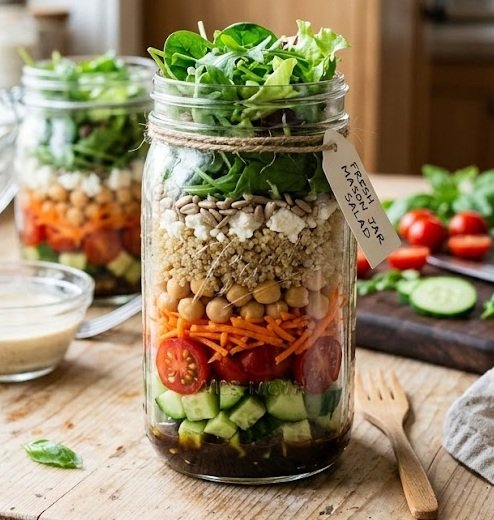
Mason jar salads might become your new favorite meal-prep solution. These colorful layered salads are easy to prepare, simple to transport, and stay surprisingly fresh for days in the refrigerator. The secret is all in the layering. By placing the dressing at the bottom and delicate greens at the top, every ingredient stays crisp until you’re ready to eat.
Mason jar salads are perfect for work lunches, school meals, picnics, road trips, or simply preparing healthy meals ahead of time. Once you learn the basic formula, you can create endless flavor combinations using your favorite vegetables, proteins, grains, nuts, and dressings.
Main Essence of This Dish
- Perfect for meal prep and busy weekdays.
- Keeps salad ingredients fresh and crisp.
- Easy grab-and-go lunch option.
- Highly customizable with different vegetables and proteins.
- Balanced meal packed with fiber, vitamins, and protein.
- Can be prepared several days in advance.
What Are Mason Jar Salads?
Mason jar salads are layered salads assembled inside glass mason jars. The ingredients are arranged in a specific order to prevent moisture from reaching the greens too soon. This method helps maintain texture and freshness while making storage and transportation incredibly convenient.
Ingredients
For the Dressing
- 3 tablespoons olive oil
- 1 tablespoon lemon juice
- 1 teaspoon Dijon mustard
- 1 teaspoon honey
- 1/4 teaspoon salt
- 1/4 teaspoon black pepper
For the Salad
- 1/2 cup cucumber, diced
- 1/2 cup cherry tomatoes, halved
- 1/2 cup shredded carrots
- 1/2 cup cooked chickpeas
- 1/2 cup cooked quinoa
- 1/4 cup red onion, finely sliced
- 1/4 cup crumbled feta cheese
- 2 cups mixed salad greens
- 1 tablespoon sunflower seeds
Also Read: Caesar Dressing for Salad
Equipment Needed
| Equipment | Purpose |
|---|---|
| 32-ounce Mason Jar | Stores and layers the salad |
| Mixing Bowl | Prepare dressing |
| Measuring Cups | Portion ingredients |
| Sharp Knife | Chop vegetables |
How to Make Mason Jar Salads
- In a small bowl, whisk together olive oil, lemon juice, Dijon mustard, honey, salt, and pepper until smooth.
- Pour the dressing into the bottom of a clean mason jar.
- Add sturdy vegetables that can handle moisture, such as cucumbers, carrots, and onions.
- Layer the cherry tomatoes on top.
- Add chickpeas and cooked quinoa to create a barrier between the dressing and greens.
- Sprinkle feta cheese and sunflower seeds over the grain layer.
- Fill the remaining space with mixed salad greens.
- Seal the jar tightly with a lid and refrigerate.
- When ready to eat, shake the jar gently to distribute the dressing, then pour into a bowl and serve.
Also Read: Cucumber Tomato Onion Salad Recipe
The Best Layering Order
| Layer | Ingredients | Purpose |
|---|---|---|
| 1 | Dressing | Prevents greens from becoming soggy |
| 2 | Hard Vegetables | Creates a protective barrier |
| 3 | Beans and Grains | Adds protein and keeps layers separate |
| 4 | Cheese and Seeds | Adds flavor and texture |
| 5 | Leafy Greens | Stays fresh and crisp until serving |
Flavor Variations
Mediterranean Mason Jar Salad
- Chickpeas
- Cucumber
- Olives
- Feta cheese
- Romaine lettuce
Southwest Mason Jar Salad
- Black beans
- Corn
- Bell peppers
- Avocado
- Cilantro lime dressing
Chicken Caesar Mason Jar Salad
- Grilled chicken
- Parmesan cheese
- Romaine lettuce
- Croutons
- Caesar dressing
Also Read: Ciabatta Bread Recipe
Storage Tips
- Store jars upright in the refrigerator.
- Keep lids tightly sealed.
- Use fresh and dry greens for the best results.
- Consume within 4 to 5 days.
- Add avocado only before serving to prevent browning.
Nutritional Information
Approximate values per serving.
| Nutrient | Amount |
|---|---|
| Calories | 385 kcal |
| Protein | 15 g |
| Carbohydrates | 34 g |
| Fiber | 10 g |
| Sugar | 6 g |
| Fat | 20 g |
| Saturated Fat | 4 g |
| Sodium | 420 mg |
| Potassium | 620 mg |
Also Read: Hibachi Chicken Recipe
Common Mistakes to Avoid
- Putting greens directly in contact with dressing.
- Using wet lettuce without drying it properly.
- Overfilling the jar and making it difficult to mix.
- Adding delicate ingredients too early.
- Using jars that are too small for meal-sized portions.