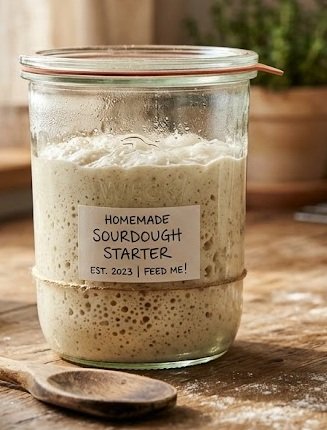
A sourdough starter is a living mixture of flour and water that captures natural wild yeast and beneficial bacteria from the environment. Over time, this simple mixture becomes active enough to help bread rise naturally without commercial yeast. Making your own starter requires only two ingredients and a little patience, but the reward is a flavorful starter you can use for years.
Main Essence of This Dish
The heart of a sourdough starter is natural fermentation. Flour and water work together to attract wild yeast and beneficial bacteria, creating a bubbly culture that gives sourdough bread its signature tangy flavor, chewy texture, and excellent rise. While the process takes about a week, most of the work involves short daily feedings.
Ingredients
| Ingredient | Amount |
|---|---|
| All-Purpose Flour | 60 grams (1/2 cup) per feeding |
| Whole Wheat Flour (Optional for Faster Activity) | 60 grams (1/2 cup) per feeding |
| Filtered or Non-Chlorinated Water | 60 grams (1/4 cup) per feeding |
Equipment Needed
- 1 clean glass jar or container
- Kitchen scale for accurate measurements
- Spoon or spatula
- Loose lid or clean cloth
Also Read: Oven Roasted Cauliflower Recipe
How to Make Sourdough Starter
Day 1: Create the Starter
In a clean glass jar, mix 60 grams flour and 60 grams water until smooth. Scrape down the sides of the jar and cover loosely. Leave at room temperature for 24 hours.
Day 2: Check for Activity
You may notice a few tiny bubbles or no activity at all. This is normal. Stir the mixture and leave it undisturbed for another 24 hours.
Day 3: First Feeding
Discard about half of the starter. Add 60 grams fresh flour and 60 grams water. Mix thoroughly, cover loosely, and let it rest at room temperature.
Day 4: Continue Feeding
Discard half of the mixture again. Feed with 60 grams flour and 60 grams water. You should begin to see more bubbles and notice a mild fermented aroma.
Day 5: Build Strength
Repeat the discard-and-feed process. The starter may begin rising and falling during the day, showing that fermentation is becoming more active.
Day 6: Watch for Growth
Feed the starter again after discarding half. By now, it should be noticeably bubbly and may double in size within several hours after feeding.
Day 7: Ready for Baking
Your starter should smell pleasantly tangy and consistently rise after feeding. If it doubles in volume within 4 to 8 hours, it is ready to use in sourdough recipes.
Also Read: Zucchini Fritters Recipe
Signs Your Sourdough Starter Is Ready
- It doubles in size after feeding.
- It contains bubbles throughout the mixture.
- It smells fresh, tangy, and slightly yeasty.
- It rises and falls predictably every day.
Storage and Maintenance
If you bake frequently, keep your starter at room temperature and feed it daily. If you bake occasionally, store it in the refrigerator and feed it once a week. Before baking, remove it from the refrigerator, feed it, and allow it to become active and bubbly.
Common Problems and Solutions
| Problem | Cause | Solution |
|---|---|---|
| No bubbles after several days | Cold room temperature | Move to a warmer location and continue feeding |
| Liquid layer on top | Starter is hungry | Discard liquid if desired and feed normally |
| Very strong sour smell | Needs more frequent feeding | Feed every 12 hours for a few days |
| Mold growth | Contamination | Discard starter and start over |
Also Read: Roasted Sweet Potatoes Recipe
Nutritional Information
Approximate nutrition per tablespoon of active starter.
| Nutrient | Amount |
|---|---|
| Calories | 12 |
| Carbohydrates | 2.5 g |
| Protein | 0.4 g |
| Fat | 0 g |
| Fiber | 0.1 g |
| Sodium | 0 mg |
Expert Tips for Success
- Use filtered or dechlorinated water whenever possible.
- Keep the starter in a warm environment between 70°F and 75°F (21°C to 24°C).
- Use a kitchen scale for consistent results.
- Do not tightly seal the container during fermentation.
- Patience is key, some starters may take more than a week to fully mature.
Also Read: Corn Chowder Recipe
Frequently Asked Questions
Can I use whole wheat flour instead of all-purpose flour?
Yes. Whole wheat flour often helps a starter become active faster because it contains more natural nutrients and microorganisms.
How long does a sourdough starter last?
A well-maintained sourdough starter can last for many years. Some starters have been kept alive for decades.
Do I have to discard part of the starter?
Yes. Discarding keeps the starter manageable and ensures the yeast receives enough fresh food during feedings.
Can I refrigerate a new starter?
Wait until the starter is fully active and mature before storing it in the refrigerator.
What should a healthy starter smell like?
A healthy starter should smell mildly tangy, yeasty, fruity, or slightly like yogurt. It should not smell rotten or moldy.